

Dear Colleagues,
Updates from the Team
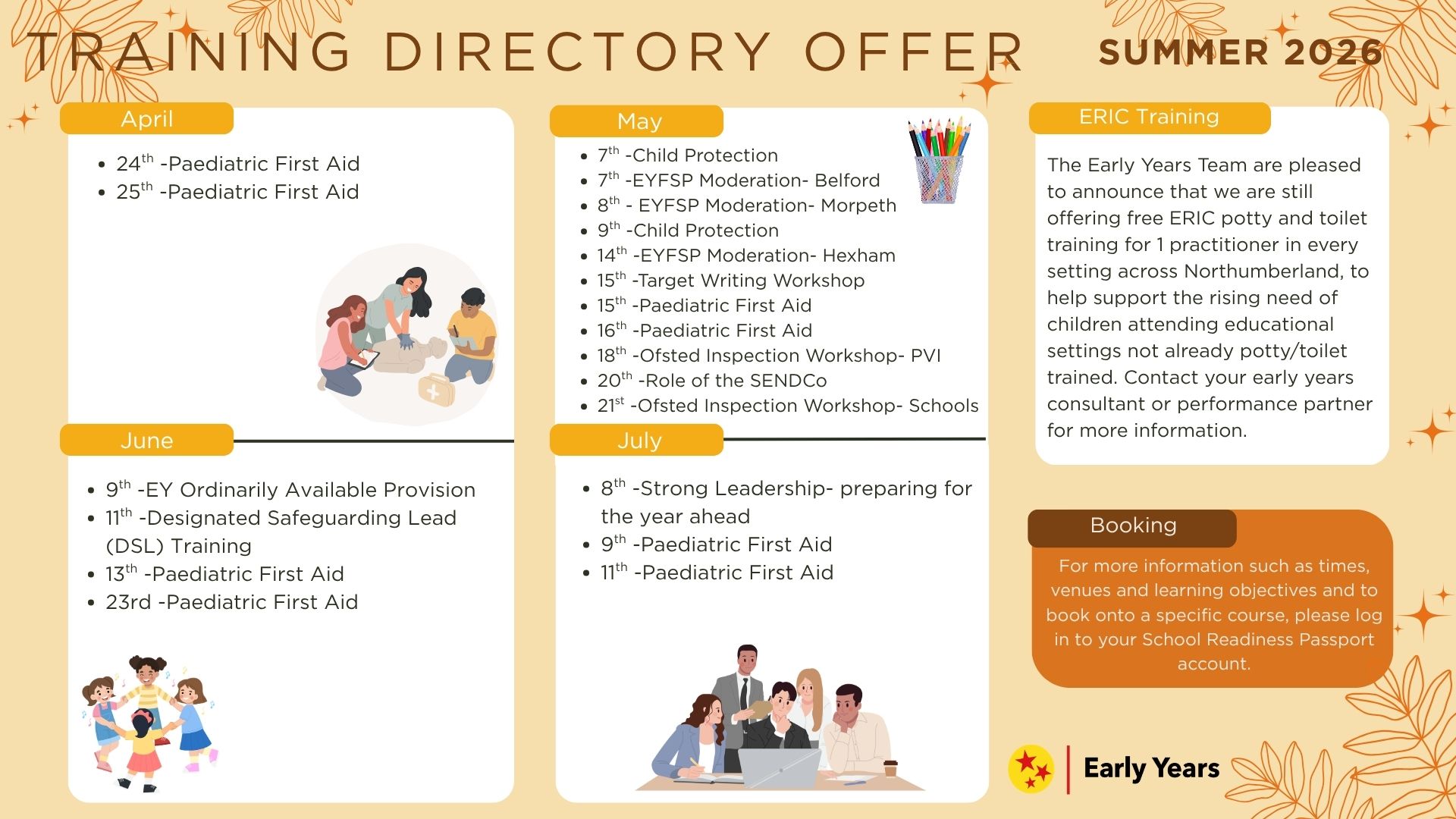
Training Offer- Summer 2026
Please find attached our summer training offer for April-July 2026 and flyer. All courses are available to book via the School Readiness Passport. SLA permissions may be required.
Preparing for Transition
Reception Ready Checkers are now open on the School Readiness Passport. Please complete these in preparation for children starting in Reception in September and in advance of the transition networks running over the next two weeks. If you are working with children with SEND and are assessing them against the SEND Support Checker, please also make sure this is accurate and up to date. All other aspects of the Passport should also be reviewed to ensure they are accurate and reflect the child. If you need any help completing assessments on the Passport please contact your locality Early Years Consultant or Performance Partner.
Early Years Leaders Briefings
We have a jam packed Leader’s Briefing for you this term. Further details including booking links are in the flyer attached.
Are you Up to Date with the National Minimum Wage Increase from April 2026?
The National Minimum Wage (NMW) and National Living Wage (NLW) rates increased on 1 April 2026. HMRC have outlined the key steps you need to take and where to find support.
You can find more information on the new minimum hourly pay rates for workers and apprentices on GOV.UK.
Apprentices
Apprentices are entitled to the apprentice rate if they are either:
- aged under 19
- aged 19 or over and in the first year of their apprenticeship
What you need to do now:
- check the new rates and identify which members of staff could be affected
- review any deductions, salary sacrifice schemes or unpaid working time, as these can affect whether you are meeting your NMW obligations as an employer, mistakes are common and often unintentional
Guidance and support
Calculating NMW correctly involves more than simply applying the right hourly rate. Visit GOV.UK and search ‘calculating the minimum wage‘.
HMRC has a catalogue of free recorded webinars available, which you can watch at any time to help you avoid mistakes. They include information on topics such as ‘salary sacrifice’, ‘working time’, ‘helping employers get things right’, and ‘common mistakes and how to spot them’. You can find these webinars on GoToStage.com.
Ofsted Inspection Workshops
The Early Years Team is delivering a one-off workshop for PVIs, and another for schools, to help you assess yourself against the new Ofsted Inspection Toolkit. To sign up to the PVI session, please complete this form: Ofsted Inspection Toolkit Workshop for PVIs 18th May 2026 – Fill in form
To sign up to the school session, please complete this form: Ofsted Inspection Workshop for Schools Thursday 21st May – Fill in form
School Food Standards Consultation
The DfE launched a Consultation on April 13th. This is because the current School Food Standards are over a decade old and need updating to bring them in line with the latest nutritional guidance and scientific advice.
We really encourage you to engage with this key consultation and to share as widely as possible with your parents/carers to ensure DfE capture a wide range of views as they move forward with this work.
The consultation is open until 11.59pm on 12 June.
To find out more and get involved, go to the consultation page on GOV.UK.
School Readiness Passport Survey
As you know, in Northumberland we use the School Readiness Passport online platform to encourage collaborative partnership working to ensure all children including those with SEND are supported through effective transitions, the monitoring of actions to support progress, early identification of needs through a robust assessment tool and the analysis of data.
The Passport will be a key tool used to support Northumberland to implement our Best Start in Life Local Plan. We therefore want to ensure it meets the needs of providers effectively. We would be extremely grateful if you could take a few minutes to complete the survey. SchoolReadiness Passport Survey – Fill in form
If you do not use the School Readiness Passport system currently, we would still appreciate your feedback.
Updates from Partners
Family Hubs – Calm Stay and Play Sessions
Please find flyer attached for further information. There is no referral needed, families are welcome to drop in.
Advice for Early Years Settings – sleeping space for babies
The Minister for Early Education and Minister for Equalities has written to inform early years providers of amendments that the department intends to make to the Early Years Foundation Stage (EYFS) statutory frameworks this year. (2026) This is what she has said – see attached also.
Our primary objective is to clarify the safeguarding requirements for sleeping arrangements, as part of our comprehensive review of the proposals raised through the Campaign for Gigi.
Genevieve Meehan’s death in 2022 was a devastating tragedy that should never have happened. Children’s safety is at the very heart of this government’s plan for change and, as Minister for Early Years, the safety of our children is my utmost priority. It is already expected that early years providers must put children down safely to sleep. All early years providers are required to meet the safer sleep requirements set out in the EYFS statutory framework, which currently links to the NHS safer sleep guidance. Providers should have already taken action to ensure that they are acting in accordance with the NHS guidance and urge all providers to ensure that they are doing so.
To make this absolutely clear, I am updating the wording in the EYFS framework so that requirements around safer sleep are set out directly within the framework itself. These changes will come into effect from September 2026, subject to the parliamentary and legislative process but providers must already be compliant with them now.
This updated wording has been developed with input from the Lullaby Trust, medical experts and Ofsted and is as follows:
Babies and children must be placed down to sleep safely. For children under 2 years old, providers must ensure that:
Children are placed down on their back in their own separate sleep space on a firm flat surface such as a cot, bed or mattress on the floor. Babies aged 1 year and under must only be placed to sleep in a cot.
Sleep spaces should only contain a firm, flat, waterproof mattress and lightweight bedding which is firmly tucked in around the child below their shoulders to prevent head covering. Alternatively, a well fitted baby sleep bag may be used. Check the manufacturer recommendations before using a baby sleep bag.
Where blankets are used, the child is placed feet-to-foot at the bottom of the cot, with blankets tucked in.
Cots must not contain extra items such as toys, pillows, extra blankets, bumpers, wedges or straps.
Children should not get too hot or cold. The recommended room temperature for babies is 16 – 20˚C.
Children’s heads are not covered.
Children under six months of age must always have an adult with them in the same room for every sleep. All children must be frequently checked when sleeping.
Children are always within sight and hearing of staff when sleeping.
Providers must ensure that all staff read NHS advice on Sudden infant death syndrome (SIDS) – NHS. More information on safer sleep guidance is available from The Lullaby Trust.
My department continually monitors and reviews safeguarding requirements for early years settings to make sure children are kept as safe as possible. When changes are made to the EYFS statutory frameworks, the Department ensures there is a comprehensive programme of communications and engagement with the sector to support understanding of the changes.
Olivia Bailey MP
Minister for Early Education and Minister for Equalities
Starting Reception
Starting school is an exciting milestone. To help make the transition into Reception as smooth and positive as possible, DfE encourage settings to share the following resources with parent.
Starting Reception Guide (Downloadable PDF)
Starting Reception is a free, practical online resource designed to support parents and carers in preparing their child for school. It offers simple activities, helpful advice and clear guidance on the key skills and routines that help children feel confident and ready for their first day.
Starting Reception have also provided guides for Potty Training and Children’s Toothbrushing. Children being able to use the toilet independently and having healthy routines such as brushing their teeth is an important part of getting ready for starting school.
- Potty Training Guide website
- Potty Training Guide (Downloadable PDF)
- Children’s Toothbrushing Guide website
- Children’s Toothbrushing Guide (Downloadable PDF)
Best Start in Life – Preparing for School Launch
As part of the Government’s Early Years strategy, the Best Start in Life campaign brings together trusted advice and support to help families recognise how everyday moments support children’s development and build the skills they need for starting school.
DfE have launched Preparing for School – part of the wider Best Start in Life campaign – to support parents in preparing their child for starting school this September. The campaign highlights that being prepared is about developing everyday skills, not just having the right uniform.
At the heart of the campaign is the Steps for School song – a new music video featuring a rap by award-winning teacher-turned-rapper MC Grammar. The video highlights simple, practical steps parents can practice with their child to support their development and build confidence and independence.
You can watch and share the video here: Steps For School Song | @Best Start in Life + @MC Grammar
DfE also encourage parents to explore the new Preparing for school webpage on Best Start in Life, which brings together helpful guidance and tips: Preparing for school – Best Start in Life
Please share the video and webpage across your channels to help reach more families.
Further campaign resources will be available shortly via the Campaign Resource Centre, including communications toolkits and social media assets. If you haven’t already, please sign up to access and use these materials as soon as they are released in the coming weeks.
Call for Evidence: Evidence-Based Interventions to Improve Quality and Performance in Children and Young People’s Health
NHS England and the Department of Health and Social Care are launching a national call for evidence to improve health services for children and young people (CYP) in England as part of a Modern Service Framework (MSF) to deliver a step-change in child health over the next decade. Particularly improving quality and performance of CYP health services.
MSFs were announced in the 10 Year Health Plan to support consistent, high quality, and high value care in a specific area. The CYP MSF will bring together a focused set of evidence-based interventions that make the greatest difference to effectiveness, safety and experience across children and young people’s pathways. It will set out the long-term outcomes we aim to achieve, provide clear standards to support impactful care, and highlight where new innovations could accelerate system improvements.
To do this, they need your contributions.
What they are asking you to do:
- Submit evidence of interventions that improve outcomes, quality of care or system performance for children and young people.
- Complete the survey: CYP Call for Evidence Survey
Deadline: 17:00, 24th April
Submissions
All settings are encouraged to submit. Submissions should focus on:
- Interventions for babies, children and young people aged 0–18 (up to 25 for those with SEND, MH needs, or disability). Maternity and neonatal care are out of scope.
- Support for specific clinical areas and / or the whole-child including interventions addressing mental and physical health.
- Services within the ICB commissioning remit. Wider governmental services are out of scope.
Types of interventions
They are seeking both broader service model transformations, including pathway transformations and delivery approaches, as well as more specific clinical and digital interventions. We welcome examples at all stages of maturity. This includes evidence-based interventions already delivering impact or programmes which are no longer active, as well as emerging models and early-stage pilots showing promising results. We may contact contributors for further information if required.
How to contribute
Complete the survey here: CYP Call for Evidence Survey. It closes at 17:00 on Friday 24th April.
If you wish to submit more than one intervention, you must complete a separate form for each intervention. If you have any questions or need support, please contact the CYP MSF team at: england.cyp.msf@nhs.net.
Updated guidance for childminders on claiming household expenses
HMRC has published guidance for childminders on how they can continue to claim household expenses, including wear and tear costs deductions, whether they use Making Tax Digital for Income Tax or not. The new guidance and the updated Business Income Manual guidance can be found on GOV.UK.
Key points from the guidance:
1. All childminders can claim a deduction for costs of buying, repairing or replacing household items used for their business, including wear and tear of household items and furniture, household costs and food and drink, whether they use Making Tax Digital or the alternative rules for the sector.
2. Only those with qualifying income above £50,000 will begin using Making Tax Digital from 6 April 2026. In 2027 the qualifying income threshold will drop to £30,000 and then in 2028 to £20,000.
3. If childminders use Making Tax Digital they will record and claim their actual expenditure on buying, repairing or replacing household items and furniture, which can be higher than 10% in some instances. If they are still using the alternative method, they will continue to claim for ‘wear and tear’ using the flat 10% estimate.
To help childminders understand and reassure them that they will not lose the ability to claim business expenses, please can you:
· circulate this guidance to stakeholders in your network who are able to reach the industry
· amplify our social media posts on LinkedIn, Facebook and Instagram.
The government will actively engage with childminders and stakeholders to review the impacts of moving from the 10% deduction to actual costs for wear and tear expense claims.
Please do get in touch if you have any questions or would like further information. You can also find out more information about Making Tax Digital for Income Tax on HMRC’s campaign page.
